
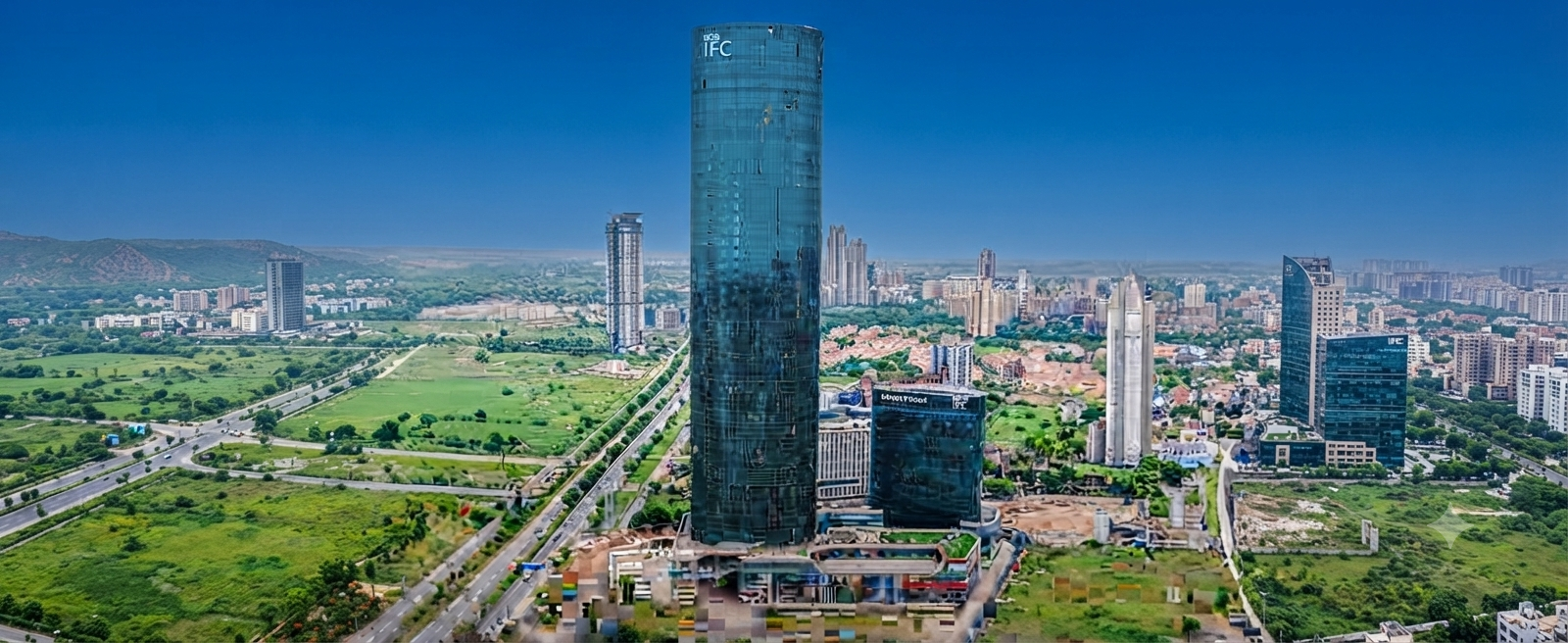
Sector 66, Gurugram
M3M IFC resale
Every listing is confirmed with the owner before it goes live, and re-confirmed every 30 days.
- Status
- Delivered
- Corridor
- Golf Course Extension Road
Resale units in M3M IFC
No units listed right now
Inventory here moves quickly and not everything reaches the site. Tell us what you're looking for and we'll call the moment something matches.
What stands out
- Delivered and trading. M3M's own project list files both the office and the retail component under delivered — you can go and inspect the building before you buy.
- Two different products under one name: bare-shell office floors in the tower, and retail and F&B units on the lower levels. The rates are not comparable.
- Restaurant levels are open. Walk them at lunch and again on a Saturday evening before you accept anyone's account of how busy the scheme is.
- On Golf Course Extension Road in Sector 66. There is no metro station on this corridor today — everything arriving here arrives by road.
- Ask what is being handed over: bare shell, warm shell, or a fitted suite. It is the single biggest unpriced variable in an office resale.
- The promoter company of record is not M3M India itself. Establish who signs the transfer NOC before you pay a token amount.
- CAM is not published for this scheme. Get the current rate and a no-dues certificate in writing — arrears follow the unit, not the seller.
About M3M IFC
M3M IFC — the International Financial Centre — sits in Sector 66, Gurugram, on Golf Course Extension Road. M3M's own project list files it under delivered for both its office and its retail component, and the restaurant levels are open and trading. That fact governs everything about buying here.
A finished, occupied commercial building can be inspected, and almost nobody bothers. Go on a Tuesday at one in the afternoon and again on a Saturday evening. Count the shutters that are down. Ask the security supervisor how many floors are occupied. None of that is available to someone buying off a floor plan, and it is the whole advantage of buying resale.
Two different assets, one address
Office and retail sit inside the same building and behave nothing alike. Establish which one you are being shown before anyone quotes a rate per square foot, because the two are not comparable numbers.
Office space in the tower is ordinarily sold bare shell — a slab, a core, and services brought to the floor. The fit-out is yours or your tenant's. Ask the seller specifically what is being handed over: bare shell, warm shell, or a suite left fitted by a previous occupier. That difference is real money and it is routinely glossed over in a listing.
Retail and F&B units occupy the lower levels, which M3M describes as an air-conditioned boulevard across the ground, first and second floors. A restaurant unit is a purchase of its own kind: you may be buying a shell with an operator's fit-out standing in it, and who owns that fit-out when the lease ends is a clause, not an assumption.
Occupancy is the asset, not the address
In commercial property the building's trading condition is most of what you are paying for. A unit in a half-empty scheme and a unit in a busy one are different assets at the same rate per square foot, and no brochure tells them apart.
So look at the unit, not the building's reputation. Which level is it on, and does that level get walked? Is it on the path between the lift lobby and the food, or around a corner from it? Ground-floor frontage on a working boulevard and a second-floor unit behind the escalator are not the same investment.
We publish no footfall figures for this project, because we have no source we would stand behind. If a seller quotes one, ask where it came from and for what period.
If the unit comes with a tenant
A pre-leased unit is bought for its lease, so read the lease before you read the listing. The things that decide what you are actually buying:
- Lock-in and remaining term. A lease with eight months left and one with six years left are different assets.
- Whether the lease survives the sale, and whether the tenant must consent.
- Escalation — how much, how often, from what date.
- The security deposit. Does it pass to you at closing, or does the seller keep it and leave you owing it back at the end?
- Rent actually received, not rent contracted. Ask for bank statements.
On assured returns and guaranteed rentals, one point is worth more than all the rest. An assured return is not a feature of the unit. It lives in a document — an MoU, an addendum, or a clause in the original buyer's agreement — between the developer and the person who bought first. It does not automatically follow the shop or the office floor to you, and we can find no authority saying it does. Treat it as transferring only if that document is itself assigned to you and the developer's transfer endorsement names it, in writing.
The rest follows from that: which named company is bound, and what the unit genuinely lets for on the open market the day the arrangement ends. We publish no return figure for this project.
What the purchase costs beyond the price
CAM. Charged monthly, ordinarily on the chargeable or super area rather than the carpet, and in an air-conditioned scheme it is not a small number. It is not published. Get the rate in writing from the maintenance agency, ask what it covers, and get a no-dues certificate — arrears attach to the unit, not to the seller.
GST. Commercial behaves differently from residential. A completed unit sold after its occupancy certificate is a transfer of immovable property and does not attract GST the way a booking in an unfinished building does; a unit without an OC is a different case, and so is the treatment of rent once you own it. Have a chartered accountant confirm all three against the specific unit.
Transfer, or registry. A registered deed means an ordinary sale, with stamp duty and registration paid to the state and the developer not involved. An unregistered unit goes back through the developer as a transfer, with its charges and its no-objection certificate — usually costlier on commercial than on a flat. The promoter company of record here is not M3M India itself, so establish early who signs.
Where we do not hold the answer, we say so and go and find it rather than filling the gap with an estimate. If anything here is wrong, tell us and it is corrected the same day.
What's nearby
- Golf Course Extension Road
- On the corridor
- Sector 65-66 crossing for Sohna Road
- Golf Course Road and the Sector 55-56 Rapid Metro
- Sohna Road office and retail belt
- Cyber City / DLF office belt
- NH-48 via Sohna Road or Golf Course Road
- Residential catchment in Sectors 65, 66 and 67
Amenities
What is built and running today — not what the brochure promised.
- Air-conditioned retail boulevard
- Restaurants and cafes trading on the retail levels
- Passenger and service lifts
- Power backup
- CCTV surveillance and manned security
- Managed reception and building lobby
- Basement and structured car parking
Questions about M3M IFC
Answered from what we actually hold on this project, and updated as listings change.
Something we have not covered? Ask us — if it is worth answering here, it goes on the page.